
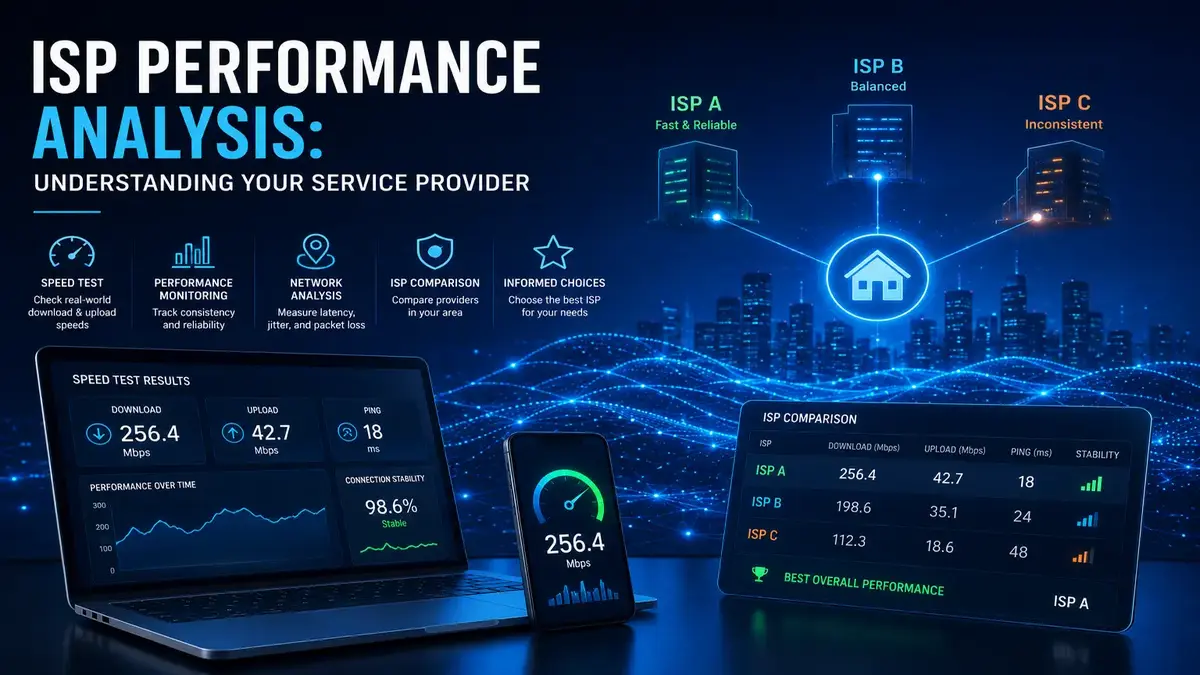
ISP Performance Analysis: Unlock Better Performance
Table of Contents
Choosing the right internet service provider shapes nearly every part of your online experience, from how quickly a webpage loads to whether a video call stays crisp during a big presentation. Yet most households pick an ISP once and rarely revisit that decision, even as network conditions, pricing, and available technologies change year after year. This guide walks through how to evaluate an internet service provider’s real-world performance,
What ISP Performance Analysis Really Measures
When people talk about ISP performance, they are usually referring to a handful of measurable characteristics: download speed, upload speed, latency, jitter, and reliability over time. Download and upload speed describe how much data can move in each direction per second, typically expressed in megabits per second (Mbps) or gigabits per second (Gbps). Latency measures the delay before a packet of data begins to transfer, while jitter captures how consistent that delay is from one moment to the next. Reliability, meanwhile, reflects how often the connection drops, slows down during peak hours, or fails to deliver the speeds promised in your plan.
Each of these metrics matters for different activities. A household that mostly browses the web and streams video in standard definition can tolerate more latency than one that relies on real-time video conferencing or competitive online gaming. Understanding which metrics matter most for your household is the first step toward evaluating whether your current ISP Performance Analysis is actually serving your needs.
Advertised Speed Versus Real-World Speed
Internet service providers advertise “up to” speeds, a phrase that carries a lot of legal weight and very little practical guarantee. Advertised speeds represent the theoretical maximum under ideal conditions, not the speed you will consistently receive. Real-world speed is affected by network congestion, the quality of in-home wiring, the distance from a node or exchange, and the number of other subscribers sharing the same local infrastructure at any given moment.

How to Properly Test Your ISP Performance Analysis
Accurately assessing your internet service provider requires more than a single speed test taken at a random moment. Because network conditions fluctuate throughout the day, a meaningful evaluation should include multiple tests spread across different times, days, and usage conditions.
- Run tests at different times of day, including peak evening hours when neighborhood usage is highest
- Test with a wired Ethernet connection whenever possible to eliminate Wi-Fi as a variable
- Compare results across at least two independent testing services to rule out server bias
- Record results over a full week to identify patterns rather than one-off anomalies
- Test both download and upload speeds, since many plans are asymmetric
Once you have gathered a week or two of consistent data, compare the average results against the plan tier you are paying for. Occasional dips of ten to fifteen percent below the advertised number are common and generally acceptable, but consistent shortfalls of thirty percent or more suggest a genuine service issue worth raising with your provider.
Comparing Connection Technologies
Not all internet connections are built the same way, and the underlying technology has a significant impact on the ISP Performance Analysis ceiling you can expect from a given provider. Fiber-optic connections generally offer the highest and most symmetric speeds, since data travels as pulses of light with minimal signal degradation over distance. Cable connections, delivered over the same coaxial infrastructure used for television, offer strong download speeds but often more limited upload speeds because of how the network is architected. Digital subscriber line (DSL) connections run over traditional telephone wiring and tend to degrade noticeably with distance from the provider’s central office.
Why Technology Choice Affects Long-Term Value
When comparing internet service providers, it helps to look beyond the introductory price and consider what connection technology underlies the offer. A fiber plan priced similarly to a cable plan will usually deliver a more consistent and future-proof experience, since fiber infrastructure has substantially more room to scale as household bandwidth needs grow. Cable networks can be upgraded too, but often require more significant infrastructure investment from the provider to keep pace with rising demand.
Reading the Fine Print: Data Caps, Contracts, and Fees
ISP Performance Analysis is not just about speed; it also includes the conditions attached to your service. Many providers impose monthly data caps that, once exceeded, trigger additional charges or throttled speeds for the remainder of the billing cycle. Others require multi-year contracts with early termination fees, or advertise a promotional rate that increases substantially after the first twelve months. A thorough performance evaluation should factor in these hidden costs, since a slightly slower plan with no data cap and transparent pricing may deliver better overall value than a faster plan riddled with penalties and fee escalations.

Signs You Should Switch Providers
Several warning signs suggest it may be time to explore alternative options in your area. Recurring outages that are not weather-related, customer support that consistently fails to resolve technical issues, speeds that fall well below the plan tier despite a wired connection and modern equipment, and steadily rising bills without corresponding improvements in service are all reasonable justifications for shopping around. Before switching, use our ISP selection guide to compare available providers in your area and understand which connection technologies are realistically accessible at your address.
Negotiating With Your Current Provider
In many cases, simply calling your existing provider and mentioning a competitor’s offer can result in a lower rate or a free upgrade to a faster tier. Providers generally prefer to retain an existing customer over losing one, and retention departments often have more flexibility to adjust pricing than the standard sales channel. It rarely hurts to ask, and the worst outcome is typically just a polite decline.
The Role of Local Infrastructure
ISP Performance Analysis is not solely determined by the company itself; it is also shaped by the physical infrastructure serving your specific neighborhood. Two households on the same plan from the same provider can experience meaningfully different performance if one is served by newer, less congested infrastructure and the other shares an older node with dozens of heavy-usage neighbors. This is part of why online reviews of an ISP can be misleading when read in isolation; a provider that performs excellently in one part of a city may perform poorly a few miles away.
Understanding Service Level Agreements and Guarantees
Some internet service providers, particularly those serving business customers, offer formal service level agreements (SLAs) that specify guaranteed uptime percentages, maximum response times for outages, and financial credits if those commitments are not met. Residential plans rarely come with the same formal guarantees, but many providers publish informal uptime statistics or offer bill credits for extended outages if you ask. Reading through your provider’s terms of service, rather than assuming ISP Performance Analysis is entirely unregulated, can reveal remedies you did not know were available.
For business users, the stakes of ISP Performance Analysis are considerably higher, since downtime can translate directly into lost revenue, missed deadlines, or disrupted customer service. Business-grade plans often include dedicated bandwidth that is not shared with residential neighbors, along with priority technical support and faster on-site repair commitments. If your household increasingly relies on the internet for remote work, it may be worth comparing residential and small-business tiers from the same provider, since the price difference is sometimes smaller than expected relative to the reliability gained.
Monitoring ISP Performance Analysis Over Time
Rather than relying on memory or a single frustrating evening to judge your provider, consider setting up automated speed monitoring. Several free and low-cost tools can run scheduled speed tests throughout the day and log the results, building a detailed history of your connection of ISP Performance Analysis. This kind of longitudinal data is far more persuasive than an anecdotal complaint when negotiating with customer support or deciding whether to switch providers, and it can also help you catch gradual degradation that might otherwise go unnoticed until it becomes a serious problem.
How Bundling Affects Perceived ISP Performance Analysis
Many providers encourage customers to bundle internet service with television, home phone, or mobile plans, often at a discounted combined rate. While bundling can save money, it can also complicate ISP performance analysis, since a slowdown might stem from a shared piece of equipment, such as a combined modem-router-set-top-box gateway, rather than the internet connection itself. When troubleshooting performance issues in a bundled setup, it helps to isolate the internet connection from other services where possible,
It is also worth periodically reviewing whether a bundle still makes financial sense. Streaming services have replaced traditional cable television for many households, and a bundle that once offered meaningful savings may now cost more than purchasing internet service on its own combined with a handful of streaming subscriptions. Reassessing your full communications budget once a year, alongside your ISP Performance Analysis testing routine, ensures you are not paying for services you no longer need in order to receive a discount on the service you actually use most.
Regional Availability and Competition
The number of internet service providers available at a given address varies enormously depending on location. Dense urban areas often have multiple competing providers offering fiber, cable, and fixed wireless options, which tends to drive better pricing and service quality through competitive pressure. Rural and semi-rural areas, by contrast, frequently have only one or two viable options, sometimes limited to older DSL infrastructure or satellite service. In markets with limited competition, ISP Performance Analysis issues can be harder to resolve simply because switching providers is not a realistic threat.
Frequently Asked Questions
How often should I test my internet speed?
Testing once a week at varying times gives a reliable picture of ISP Performance Analysis without becoming a chore. If you suspect an ongoing problem, testing daily for a short period can help build a case to present to your provider’s support team.
Is a slower, cheaper plan ever the better choice?
Yes, particularly for smaller households with light usage. Paying for significantly more bandwidth than you actually use rarely improves everyday ISP performance once your basic streaming and browsing needs are met.
Can weather affect my ISP Performance Analysis?
Yes, especially for satellite and, to a lesser degree, fixed wireless connections, which can be disrupted by heavy rain, snow, or high winds. Wired connections like fiber and cable are far less susceptible to weather-related interference.
Why does my speed drop in the evening?
Evening hours typically see the highest number of simultaneous users in a neighborhood, which can strain shared local infrastructure, particularly on cable networks. This is often referred to as network congestion.
Does my choice of router affect ISP Performance Analysis test results?
Yes. An outdated router can bottleneck your connection regardless of how fast your ISP’s service actually is. Testing with a direct Ethernet connection to your modem removes the router and Wi-Fi from the equation entirely.
What is the difference between symmetric and asymmetric internet plans?
A symmetric plan offers equal download and upload speeds, which is common with fiber connections. An asymmetric plan, typical of cable and DSL, provides much faster downloads than uploads, which can be a limiting factor for video calls, cloud backups, and live streaming.
Should I lease or buy my modem and router?
Buying your own equipment usually pays for itself within a year or two, since providers typically charge a monthly rental fee for equipment that is often less capable than what you can purchase outright. Just make sure any equipment you buy is certified as compatible with your specific provider’s network.
Understanding how to evaluate your internet service provider empowers you to make informed decisions rather than relying on marketing claims alone. For a deeper look at how connection speed influences everyday browsing and streaming, see our internet performance guide. According to the FCC’s broadband speed guide, understanding your household’s actual bandwidth needs is the foundation for choosing a plan that delivers consistent, reliable ISP performance rather than one built around inflated advertised numbers.