Cloud Computing and Network Infrastructure Basics
Table of Contents
Every time a photo syncs to a phone automatically, a video call connects across continents, or a small business spins up a new server in minutes rather than weeks, Cloud Computing and Network Infrastructure beneath it are doing the invisible work that makes it possible. Cloud computing has fundamentally reshaped how individuals and organizations store data, run applications, and scale technology resources, but few people understand the physical and logical network infrastructure that actually delivers this seemingly effortless experience. This guide explains what cloud computing really is, how the network infrastructure supporting it works, and why the two are so deeply intertwined that neither can be properly understood without the other.
What Cloud Computing and Network Infrastructure Actually Mean
At its core, cloud computing is the delivery of computing resources, including storage, processing power, databases, and software, over the internet rather than through locally owned and maintained hardware. Instead of purchasing and operating a physical server in an office closet, a business can rent exactly the computing capacity it needs from a cloud provider, scaling up during busy periods and scaling down during quiet ones, paying only for what is actually used.
This model represents a significant shift from the traditional approach to computing infrastructure, where capacity had to be purchased in advance based on projected peak demand, often leaving expensive hardware underutilized during normal operations. Cloud computing decouples computing capacity from physical ownership, transferring the burden of hardware maintenance, security patching, and capacity planning to specialized providers who operate at a scale individual organizations rarely could match on their own.
The Three Main Service Models
Cloud Computing and Network Infrastructure are typically categorized into three broad models. Infrastructure as a Service (IaaS) provides raw computing resources like virtual machines and storage, giving customers maximum control over the software stack they run. Platform as a Service (PaaS) adds a managed runtime environment on top of that infrastructure, letting developers deploy applications without managing the underlying servers directly. Software as a Service (SaaS) goes a step further, delivering complete applications over the internet that require no infrastructure management from the customer at all, such as email or collaboration tools accessed entirely through a web browser.

The Physical Backbone Behind the Cloud
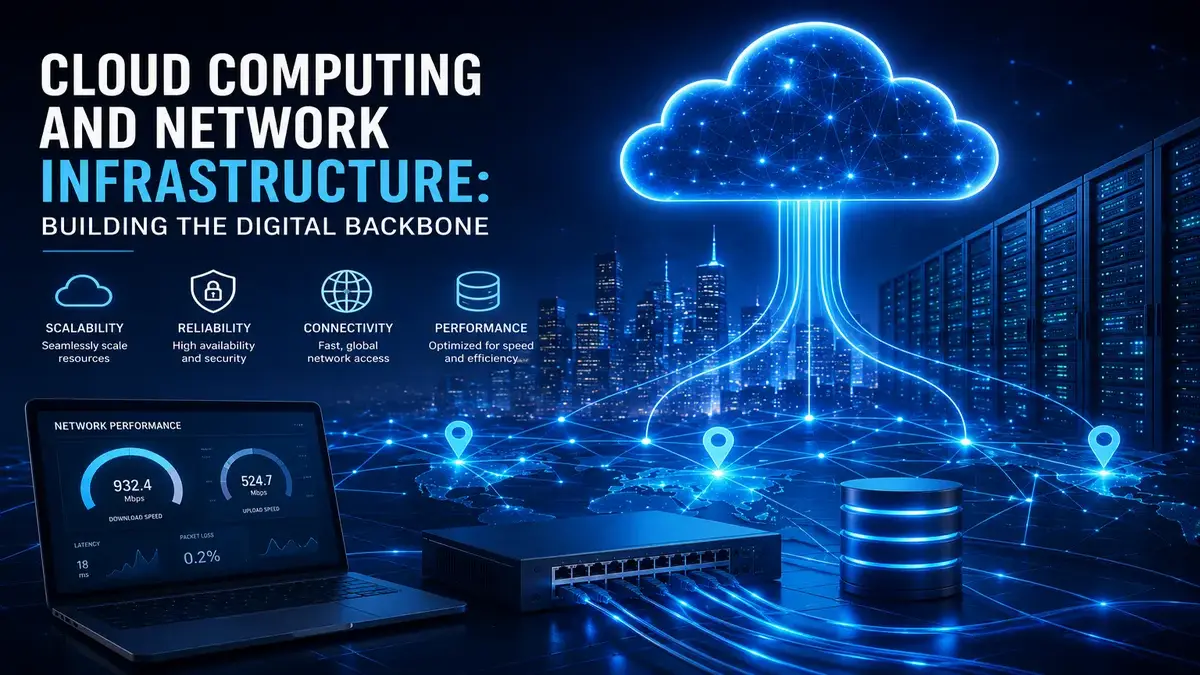
Despite the intangible name, Cloud Computing and Network Infrastructure run on very real, very physical infrastructure. Massive data centers, often the size of several football fields, house thousands of servers, cooling systems, and redundant power supplies. These facilities are connected to each other and to the broader internet through high-capacity fiber-optic networks capable of moving enormous volumes of data with minimal delay.
Cloud providers typically operate multiple data centers across different geographic regions, both to reduce latency for users in different parts of the world and to provide redundancy in case a single facility experiences an outage, natural disaster, or maintenance event. This geographic distribution is a core part of what makes cloud services resilient compared to a single on-premises server, which represents a single point of failure.
How Data Travels Between You and the Cloud
When you interact with a cloud-based application, your request travels from your device through your local network, out to your internet service provider, across the broader internet backbone, and finally to the data center hosting the specific service you are using. Each of these hops introduces some amount of latency, which is why cloud providers invest heavily in network optimization techniques such as content delivery networks, edge computing nodes, and peering agreements with major internet exchange points to minimize the distance data has to travel.
The Role of Content Delivery Networks
A content delivery network (CDN) caches frequently requested content at servers positioned closer to end users, reducing the distance data must travel and therefore the latency experienced. Many cloud providers now operate their own global CDN infrastructure as part of their broader service offering, blurring the line between traditional cloud computing and network delivery optimization.

Reliability, Redundancy, and Uptime
One of the most valuable aspects of well-architected cloud infrastructure is redundancy. Cloud providers design their systems so that the failure of any single component, whether a server, a storage device, or an entire data center, does not result in service disruption for end users. This is achieved through techniques like data replication across multiple facilities, automatic failover systems that redirect traffic away from failed components, and load balancing that distributes requests across many servers simultaneously.
Understanding uptime guarantees, often expressed as a percentage such as 99.9 or 99.99 percent availability, helps organizations evaluate how much downtime they should realistically expect from a given Cloud Computing and Network Infrastructure and plan accordingly for critical operations.
Security Considerations in Cloud Network Infrastructure
Security in a cloud environment operates on what is often called a shared responsibility model. The cloud provider is responsible for securing the underlying infrastructure, including the physical data centers, network hardware, and virtualization layer, while the customer remains responsible for securing their own data, access controls, and application configurations running on top of that infrastructure. Misunderstanding this division of responsibility is a common source of security incidents, since organizations sometimes assume the provider handles security aspects that actually remain their own obligation.
Network-level security in cloud environments includes measures such as virtual private clouds that isolate a customer’s resources from other tenants, encrypted connections between services, and sophisticated distributed denial-of-service (DDoS) protection systems that can absorb and filter malicious traffic before it ever reaches a customer’s actual application.
Hybrid and Multi-Cloud Architectures
Many organizations do not rely on a single cloud provider or a purely cloud-based approach. Hybrid cloud architectures combine on-premises infrastructure with cloud resources, often used when certain data must remain on-site for regulatory or performance reasons while other workloads benefit from cloud scalability. Multi-cloud architectures, meanwhile, spread workloads across multiple cloud providers, reducing dependency on any single vendor and sometimes optimizing costs by matching specific workloads to the provider best suited for them.
Both approaches introduce additional network complexity, since data and requests must now traverse connections between multiple environments, making network architecture and monitoring even more critical to overall system performance and reliability.
The Growing Role of Edge Computing
As applications increasingly require near-instantaneous responsiveness, particularly for use cases like autonomous vehicles, industrial automation, and augmented reality, processing data physically closer to where it is generated has become increasingly important. Edge computing extends cloud computing principles to smaller, distributed computing nodes located much closer to end users or devices than traditional centralized data centers, reducing latency for time-sensitive applications while still benefiting from centralized cloud management and orchestration.
How This Connects to Broader Connectivity Trends
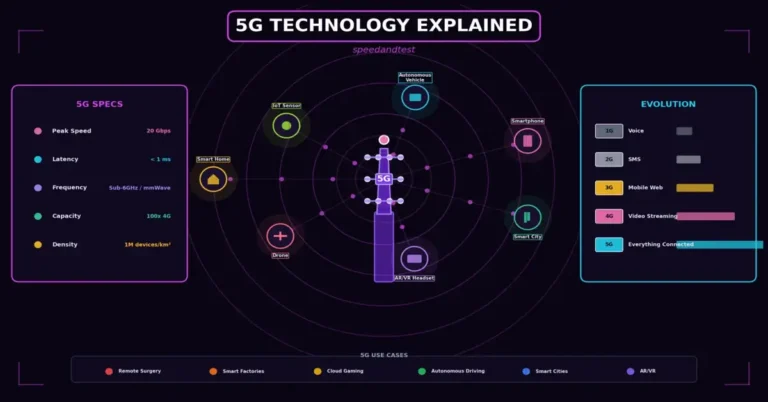
The performance of Cloud Computing and Network Infrastructure services is deeply connected to the broader evolution of internet connectivity. As networks become faster and more capable, cloud providers can push more sophisticated, real-time capabilities to end users. Our article on 5G technology and the future of internet connectivity explores how next-generation mobile networks are reshaping expectations for latency and bandwidth, while our broader look at the future of internet technology examines how these trends are converging to reshape digital infrastructure as a whole.
Network Bandwidth Requirements for Cloud Migration
Organizations planning to migrate significant workloads to the cloud often underestimate how much their internal network requirements change as a result. When applications and data move from a local server down the hall to a data center hundreds or thousands of miles away, every interaction that once traveled across a fast local area network now depends on the organization’s internet connection quality. This makes upgrading internet bandwidth and reliability a frequently overlooked prerequisite for a successful Cloud Computing and Network Infrastructure migration, rather than an afterthought to address once performance problems already surface.
Beyond raw bandwidth, dedicated connections between an organization’s premises and a specific cloud provider, sometimes called direct connect or express route services depending on the provider, offer more predictable performance and enhanced security compared to routing traffic over the public internet. These dedicated links are particularly valuable for organizations moving large volumes of data regularly or running latency-sensitive applications that cannot tolerate the variability of shared internet paths.
Planning for Data Transfer Costs and Time
Moving large volumes of existing data into a cloud environment for the first time can take considerably longer than expected if bandwidth is not carefully planned for. Some organizations with truly massive datasets even resort to physically shipping storage devices to a cloud provider’s data center rather than transferring data over the internet, simply because the available bandwidth would make an online transfer impractically slow. Understanding your actual available bandwidth, and the realistic transfer time it implies for your specific data volume, prevents unpleasant surprises during a migration project’s critical early phase.
Cost Optimization and Network Efficiency
Cloud Computing and Network Infrastructure costs are often tied directly to network usage in ways that are not always obvious at first glance. Data transfer between different regions, between a cloud environment and the public internet, or even between certain services within the same provider can incur charges that accumulate significantly at scale. Understanding a specific cloud provider’s network pricing structure and architecting applications to minimize unnecessary cross-region or cross-service data movement is an important but frequently underappreciated aspect of controlling overall cloud spending.
Caching strategies, efficient data compression, and thoughtful application architecture that minimizes redundant data transfers all contribute to both better performance and lower costs simultaneously, illustrating how network efficiency and cost efficiency are often two sides of the same underlying design decision in cloud environments.
Frequently Asked Questions
What is network latency and why does it matter for Cloud Computing and Network Infrastructure applications?
Network latency is the delay between sending a request and receiving a response. For cloud applications, higher latency translates directly into a sluggish user experience, which is why providers invest heavily in regional data centers and optimized routing to keep this delay as low as possible.
Is Cloud Computing and Network Infrastructure more secure than on-premises infrastructure?
It depends on implementation. Major cloud providers invest heavily in security expertise and infrastructure that most individual organizations cannot match, but proper configuration on the customer’s side remains essential to actually realizing those security benefits.
What happens if a Cloud Computing and Network Infrastructure data center goes offline?
Well-architected cloud services automatically redirect traffic to redundant data centers in other regions, often without any noticeable disruption to end users, though the specific failover behavior depends on how a given service is architected.
Does Cloud Computing and Network Infrastructure eliminate the need for network infrastructure?
No. Cloud computing shifts where computing resources live, but a reliable network connection remains essential to access those resources. In many ways, network quality becomes even more important in a cloud-dependent environment.
Can small businesses benefit from Cloud Computing and Network Infrastructure as much as large enterprises?
Often more so. Small businesses gain access to enterprise-grade infrastructure, security, and scalability without the upfront capital investment that would otherwise be required, leveling the playing field in ways that were not possible before cloud computing became widely available.
What is the difference between public, private, and hybrid cloud?
Public cloud resources are shared among multiple customers on infrastructure owned by the provider. Private cloud resources are dedicated to a single organization, either on-premises or hosted. Hybrid cloud combines both approaches within a single architecture.
How does edge computing differ from traditional Cloud Computing and Network Infrastructure?
Edge computing processes data closer to where it is generated, reducing latency for time-sensitive applications, while traditional cloud computing centralizes processing in large, distant data centers optimized for scale rather than proximity.
Why do data transfer costs matter so much in cloud budgeting?
Because network usage often scales directly with application activity, poorly architected data flows can silently inflate a cloud bill well beyond what the underlying compute and storage resources would suggest, making network-aware design an important cost control.
Do I need a dedicated network connection to use Cloud Computing and Network Infrastructure services?
Not necessarily for smaller workloads, but organizations with significant data transfer needs or strict latency requirements often benefit from dedicated connections that bypass the variability of the public internet.
Cloud computing and network infrastructure are inseparable; one cannot function without the other. As organizations continue migrating critical workloads to the cloud, understanding the network principles that make these services fast, reliable, and secure becomes increasingly valuable, not just for IT professionals but for anyone who depends on these systems daily. According to the National Institute of Standards and Technology’s definition of cloud computing, the essential characteristics of on-demand self-service, broad network access, and rapid elasticity remain the foundation for understanding how these systems are designed to operate at scale.