Streaming Quality and Bandwidth: Proven Ways to Improve
Table of Contents
Few things are more frustrating than settling in to watch a favorite show only to have the video suddenly drop to blurry, pixelated quality, or worse, freeze entirely while a spinning wheel mocks your patience. Streaming quality and the bandwidth required to support it are directly connected, but the relationship is more nuanced than simply “more bandwidth equals better quality.” This guide explains how Streaming Quality and Bandwidth actually work, what determines the quality you receive, and how to ensure your setup delivers the smooth, high-quality experience you are paying for.
How Streaming Quality and Bandwidth Actually Work
Modern Streaming Quality and Bandwidth services use a technique called adaptive bitrate streaming, which continuously adjusts video quality in real time based on your current available bandwidth. Rather than sending a single fixed-quality video stream, the service breaks content into small segments encoded at multiple quality levels, and your device requests whichever quality level your current connection can reliably support at that moment, seamlessly switching as conditions change throughout playback.
This adaptive approach is why Streaming Quality and Bandwidth quality can fluctuate during a single viewing session even without any change to your subscription or the content itself. A temporary dip in available bandwidth, whether from network congestion or another device on your network starting a large download, can trigger a temporary quality reduction, which then recovers automatically once bandwidth becomes available again.
Understanding Resolution and Bitrate
Video resolution, commonly expressed as measurements like 1080p or 4K, describes the pixel dimensions of the video image, while bitrate describes how much data is used to encode each second of video. Higher resolutions generally require higher bitrates to maintain visual quality, which is why 4K Streaming Quality and Bandwidth demands significantly more bandwidth than standard-definition streaming, even though both are technically “streaming video” in the same general sense.

Bandwidth Requirements by Streaming Quality and Bandwidth Quality
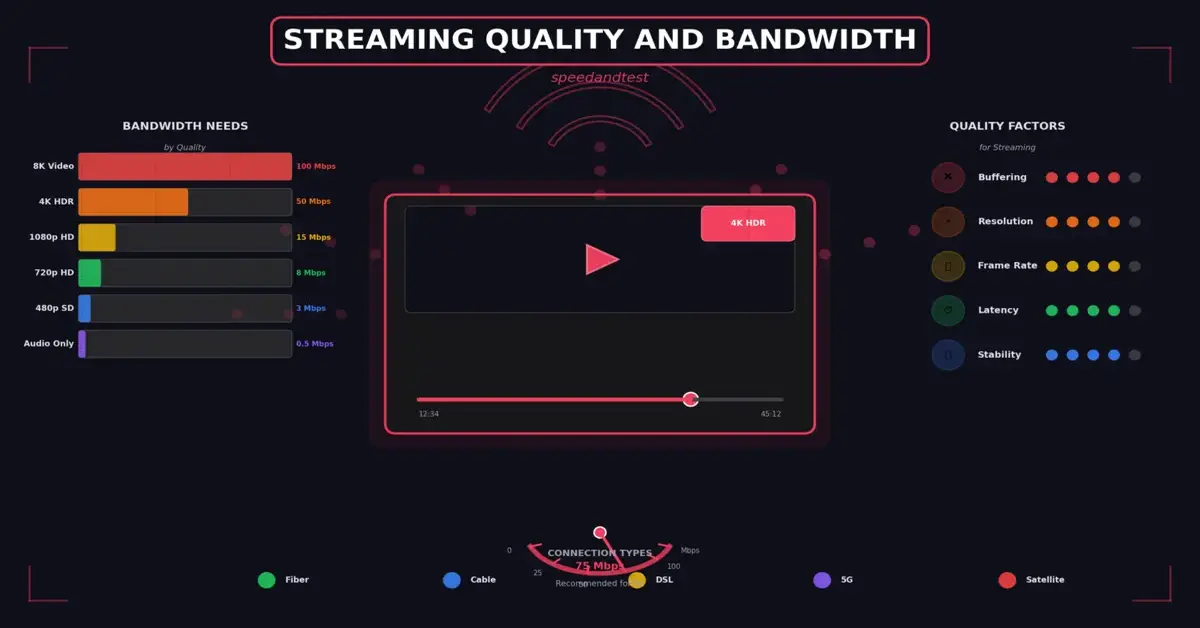
Understanding roughly how much bandwidth different sStreaming Quality and Bandwidth levels require helps you plan your internet plan and diagnose quality issues. Standard-definition streaming typically requires around 3 to 4 Mbps, HD streaming around 5 to 8 Mbps, and 4K Ultra HD streaming commonly requires 25 Mbps or more per simultaneous stream. These figures multiply quickly in households with multiple simultaneous streams, meaning a family running several 4K streams at once needs considerably more total bandwidth than any single stream’s requirement alone would suggest.
- Standard definition (480p): approximately 3-4 Mbps per stream
- High definition (720p-1080p): approximately 5-8 Mbps per stream
- 4K Ultra HD: approximately 25 Mbps or more per stream
- Multiple simultaneous streams multiply these requirements accordingly
Why Quality Drops Even With a Fast Internet Plan
A common source of confusion is experiencing poor Streaming Quality and Bandwidth despite paying for a fast internet plan. This mismatch usually stems from factors beyond your raw internet speed. Wi-Fi signal strength at the specific device streaming content, network congestion from other devices actively using bandwidth simultaneously, and even the streaming service’s own server capacity during high-demand periods can all cause quality reductions independent of your plan’s advertised speed.

How Streaming Fits Into Your Household’s Total Bandwidth Budget
Streaming rarely happens in isolation from other network activity. Video calls, cloud backups, smart home devices, and other household members’ own streaming or browsing all draw from the same shared pool of available bandwidth. Thinking of your household’s internet plan as a total budget to be allocated, rather than assuming each activity has unlimited access to the full advertised speed, helps explain why Streaming Quality and Bandwidth can suffer even on a fast plan when many activities compete for bandwidth simultaneously during busy periods like evenings and weekends.
Diagnosing Streaming Quality and Bandwidth Issues
When Streaming Quality and Bandwidth are consistently poor, a systematic diagnostic approach helps identify the actual cause. Start by testing your internet speed via a wired connection near the streaming device to establish a baseline. If wired speeds are strong but the streaming device itself uses Wi-Fi, test signal strength at that specific location, since streaming devices are sometimes placed in locations with weaker wireless coverage than where you typically run speed tests.
Optimizing Your Network for Streaming Quality and Bandwidth
Several practical steps can improve streaming reliability, particularly in households with multiple simultaneous streams or other demanding network activity. Connecting primary streaming devices via Ethernet where possible eliminates Wi-Fi variability. Enabling Quality of Service settings on your router to prioritize streaming traffic can help maintain consistent quality even when other devices are actively using bandwidth. Positioning your router centrally and away from obstructions improves Wi-Fi signal strength for wirelessly connected streaming devices throughout your home.
The Streaming Quality and Bandwidth Service’s Role in Quality
Your internet connection is only part of the equation; the streaming service itself also affects quality through its own server capacity and content delivery network infrastructure. During periods of extremely high demand, such as a major live event or a highly anticipated show’s premiere, some services may temporarily reduce default quality settings across their platform to manage overall server load, a factor entirely outside your control regardless of how strong your personal connection is.
Audio Quality as Part of the Streaming Experience
While video quality tends to dominate discussions of streaming performance, audio quality and synchronization are equally important to a satisfying viewing experience, and they depend on many of the same underlying bandwidth and network stability factors. Audio that falls out of sync with video, or that drops out briefly during playback, often stems from the same network congestion or bandwidth limitations that cause visible video quality reductions, even though the audio track itself typically requires only a small fraction of a stream’s total bandwidth compared to the video component.
Mobile Streaming Quality and Bandwidth Considerations
Streaming on cellular networks introduces additional variables beyond home Wi-Fi streaming. Signal strength, network congestion in your specific area, and data cap considerations all play a role. Many streaming apps allow manually setting a maximum quality level for cellular Streaming Quality and Bandwidth, which can help manage data usage while still providing a reasonably smooth viewing experience even on a moderate cellular connection.
How This Connects to Broader Network Performance
Streaming Quality and bandwidth are ultimately a specific application of broader network performance principles. For a deeper understanding of how latency affects real-time applications generally, see our article on the impact of network latency, and for practical steps to improve your overall connection, see our guide on how to improve your internet speed.
Understanding Codecs and Compression Efficiency
The video codec used to compress and encode streaming content plays a significant, often invisible role in the bandwidth-to-quality relationship. Newer, more efficient codecs can deliver the same visual quality at a meaningfully lower bitrate compared to older codecs, meaning two services offering “the same resolution” can actually require quite different amounts of bandwidth depending on which codec each has adopted. This is part of why Streaming Quality and Bandwidth comparisons across different services are not always straightforward, even when comparing content that appears to use identical resolution labels.
Device compatibility with newer codecs also matters, since a device must have appropriate hardware or software support to decode a given codec efficiently. Older streaming devices sometimes default to less efficient codecs or lower quality ceilings simply because they lack the processing capability to decode more modern, bandwidth-efficient formats in real time, which is a hardware limitation rather than a network or subscription issue.
Peak Hours and Internet Service Provider Congestion
Streaming Quality and Bandwidth issues that consistently occur during evening hours, when the largest number of households in a given area are simultaneously streaming, often point to congestion somewhere in the broader network path rather than a problem specific to your home setup. Internet service providers manage this shared infrastructure carefully, but during unusually high demand periods, some degree of congestion-related quality reduction can occur even for households with otherwise strong, well-optimized connections. Comparing your streaming experience at different times of day can help distinguish this pattern from a persistent, location-specific problem worth troubleshooting further.
The Growing Role of Cloud Gaming and Its Bandwidth Demands
Beyond traditional video streaming, cloud gaming services represent an even more demanding category of streaming application, requiring not just substantial bandwidth but also very low, consistent latency to remain responsive and enjoyable. Unlike video streaming, where a brief quality reduction is merely a visual inconvenience, latency spikes during cloud gaming directly translate into noticeable input lag, making a stable, low-latency connection considerably more important for this use case than raw bandwidth alone.
Frequently Asked Questions
Can audio sync issues be caused by the same problems as video quality drops?
Yes. Both frequently stem from the same underlying network congestion or bandwidth limitations, since audio and video streams are typically synchronized in real time during playback.
Why does my Streaming Quality and Bandwidth change automatically during a show?
This is adaptive bitrate streaming working as designed, automatically adjusting quality in real time based on your currently available bandwidth to prevent buffering interruptions.
Does the time of month or billing cycle affect my Streaming Quality and Bandwidth?
Not directly, unless you have a data cap that throttles speeds after being exceeded. In that case, quality may drop noticeably toward the end of a billing cycle if your cap has been reached.
How much bandwidth do I need for multiple 4K streams at once?
Each 4K stream typically requires around 25 Mbps, so three simultaneous 4K streams would require roughly 75 Mbps or more of available bandwidth just for streaming, before accounting for other network activity.
Does closing other apps on my streaming device help improve quality?
It can, particularly on lower-powered devices where background apps consume processing resources needed for smooth video decoding, though the effect is usually smaller than network-related factors.
Does a VPN affect Streaming Quality and Bandwidth?
Yes, typically. Routing traffic through a VPN adds latency and can reduce effective throughput, sometimes triggering lower automatic quality selection, though the impact varies by VPN provider and server load.
Can my router limit my Streaming Quality and Bandwidth even with fast internet?
Yes. An outdated router, particularly one that does not support current Wi-Fi standards, can become a bottleneck that limits quality regardless of how fast your underlying internet plan actually is.
Do all streaming services use the same quality settings for the same resolution label?
No. Different services use different codecs, bitrates, and encoding approaches, so two services both labeled “1080p” can look noticeably different and require different amounts of bandwidth to deliver.
Should I set a maximum quality limit manually to save data?
If you have a limited data plan, particularly on cellular, manually capping quality can meaningfully reduce data usage while still providing an acceptable viewing experience for most casual viewing.
Why does streaming buffer even though my speed test shows fast results?
A speed test measures a brief, optimized transfer, while sustained streaming over time can reveal congestion or Wi-Fi issues that a quick test might not fully capture, particularly during peak household usage hours.
Does the device I stream on affect quality?
Yes, to some extent. Older streaming devices may have processing limitations or lack support for the most efficient video codecs, occasionally resulting in lower maximum quality even with ample available bandwidth.
What is a video codec and why does it matter for streaming?
A codec compresses video data for efficient transmission. More efficient codecs deliver similar visual quality at lower bitrates, meaning codec choice can affect bandwidth needs as much as resolution does.
Is cloud gaming more demanding on my network than video streaming?
In terms of latency sensitivity, yes. While video streaming tolerates brief quality dips gracefully, cloud gaming requires consistent low latency to remain responsive, making network stability especially important.
Why is my Streaming Quality and Bandwidth worse in the evening than in the morning?
Evening hours typically see the highest overall network usage in most areas, which can introduce congestion at various points along the network path, sometimes affecting streaming quality independent of your home setup.
Can upgrading my streaming device improve quality on an unchanged internet plan?
Yes, in some cases. A newer device with better codec support and processing power can make more efficient use of the same available bandwidth, potentially improving perceived quality without any internet plan change.
Streaming quality depends on a combination of your internet speed, local network configuration, and the streaming service’s own infrastructure working together. According to Wikipedia’s explanation of adaptive bitrate streaming, this technology has become the standard approach precisely because it balances quality and reliability more effectively than any fixed-quality alternative could across the enormous diversity of real-world network conditions.