
Li-Fi Technology: How It Compares to Wi-Fi
Table of Contents
Li-Fi Technology: The 100x Faster Wi-Fi Killer Hiding in Your Light Bulb
What if the light bulb sitting above your desk right now could deliver internet speeds a hundred times faster than your Wi-Fi router? It sounds like science fiction, but Li-Fi technology is already doing exactly that in offices, hospitals, and factories around the world. If you’ve never heard of it, you’re not alone — but you’re about to understand why so many engineers think it could reshape how you connect to the internet.
You rely on Wi-Fi every single day, probably without giving it a second thought. Yet you’ve almost certainly felt the frustration of a signal that drops the moment you walk into another room, or a network that slows to a crawl when everyone in your house jumps on a video call at once. Li-Fi technology was built to solve exactly those problems, using something you already have in every room: light.
In this guide, you’ll discover what Li-Fi technology actually is, how it works, how it compares to the Wi-Fi you’re using right now, and whether it’s something you should expect to see in your own home in the near future. Let’s shed some light on it.

What Is Li-Fi Technology, Exactly?
Li-Fi stands for “Light Fidelity,” and at its core, Li-Fi technology is a form of wireless communication that uses visible light instead of radio waves to transmit data. Where your Wi-Fi router broadcasts information using radio frequencies you can’t see or hear, a Li-Fi transmitter uses ordinary LED light bulbs, flickering them on and off at speeds far too fast for your eyes to notice, to send data through the air as pulses of light.
You can think of it as an incredibly advanced, hyper-speed version of Morse code. Instead of a lighthouse keeper flashing a lamp to send a message across the water, an LED bulb above your desk flashes billions of times per second to send emails, stream video, or load a webpage onto your device. A photodetector — a small sensor built into a laptop, phone, or dedicated receiver — picks up those flickers and converts them back into the data you actually use.
The concept was first demonstrated publicly by physicist Harald Haas in 2011, and companies like pureLiFi have spent more than a decade turning it into commercially viable hardware. If you’re already comfortable with how Wi-Fi 7 pushes wireless speeds higher using radio spectrum, Li-Fi technology represents a completely different path toward the same goal: faster, more reliable wireless data.
How Does Li-Fi Technology Actually Work?
You don’t need an engineering degree to understand the basic mechanics behind Li-Fi technology, and once you see the pieces laid out, the whole idea starts to feel a lot less exotic.
The Light Source: LEDs Doing Double Duty
Every Li-Fi network starts with an LED bulb, the same basic component already lighting your kitchen or office ceiling. LEDs are semiconductor devices, which means engineers can switch their intensity on and off at extraordinary speeds without you ever perceiving a flicker. That rapid switching is what carries the data.
The Receiver: Catching the Signal
On the other end, a photodetector (sometimes built directly into a laptop dongle or smartphone case) senses the tiny variations in light intensity and translates them into an electrical signal. Specialized modulation techniques then decode that signal back into usable digital data — the same web pages, videos, and files you’d get over a traditional connection.
The Result: Blistering Speed in a Confined Space
Because visible light has an enormous amount of unregulated spectrum to work with compared to congested radio frequencies, Li-Fi technology can theoretically move enormous amounts of data. Laboratory demonstrations have already shown data rates exceeding 224 Gbps, a figure that dwarfs even the fastest Wi-Fi standards available to consumers today. In practical commercial deployments, real-world Li-Fi systems typically deliver connections in the range of hundreds of megabits per second up to a few gigabits per second, still a dramatic upgrade over a lot of everyday Wi-Fi experiences.
Li-Fi vs Wi-Fi: What’s the Real Difference?
You’ve probably already spotted the obvious distinction: one uses light, the other uses radio waves. But that single difference cascades into several practical advantages and limitations you should understand before getting too excited.
Speed Advantages
Because visible light occupies a spectrum roughly 10,000 times larger than the entire radio frequency spectrum, Li-Fi technology has enormous room to grow without the interference and congestion that plague crowded Wi-Fi channels in apartment buildings or office parks. That’s why TechRadar and other outlets frequently describe Li-Fi as capable of speeds up to 100 times faster than current Wi-Fi under ideal conditions.
Security You Can Practically See
Here’s a benefit you might not expect: because light can’t pass through walls, floors, or ceilings, a Li-Fi signal is physically contained within the room where the light source sits. If you’re in a business handling sensitive data, that containment means someone in the parking lot or the office next door literally cannot intercept your connection the way they might sniff a Wi-Fi signal leaking through a wall. This is a major reason hospitals and government facilities have shown early interest in the technology, alongside the broader push covered in our guide to home network security.
The Catch: Line of Sight and Light Dependency
Nothing is perfect, and Li-Fi technology has a built-in limitation: it generally needs a clear line of sight (or at least reflected light) between the transmitter and your device. Walk into a closet with the light off, and your connection disappears with it. That’s precisely why most experts see Li-Fi as a complement to Wi-Fi rather than a wholesale replacement, at least for now — a specialized tool for specific rooms and use cases rather than an entire home network.
Where Li-Fi Technology Is Already Being Used Today
You might assume this is all still confined to a university lab, but Li-Fi technology has quietly moved into real commercial deployments over the past several years.
Corporate Offices
Perhaps the most cited real-world example is Microsoft’s Paris headquarters, which has piloted Li-Fi installations to give employees an additional, highly secure, high-speed connection option directly from their desk lighting.
Healthcare Environments
Hospitals have a particular problem: radio frequency emissions from Wi-Fi networks can potentially interfere with sensitive medical equipment in operating theaters. Because Li-Fi uses light rather than radio waves, it sidesteps that risk entirely, making it an appealing option for operating rooms and diagnostic imaging suites.
Aviation and Confined Spaces
Airlines have also explored Li-Fi for in-flight connectivity, where radio-frequency restrictions and cabin interference are constant engineering headaches. A light-based system built into overhead reading lamps sidesteps a lot of those regulatory and technical concerns.
Industrial and Underwater Applications
Because radio waves struggle to penetrate water, researchers have even experimented with Li-Fi-style visible light systems for underwater exploration and communication between submerged equipment, a niche application that shows just how flexible the underlying technology really is.
The Companies Building the Industry
A handful of companies have driven most of the commercial progress. pureLiFi, co-founded by Li-Fi pioneer Harald Haas, released the first commercially available Li-Fi system back in 2013 and continues to develop enterprise-grade hardware. Oledcomm, a French company, has focused heavily on office and smart-lighting integrations. Signify (the company formerly known as Philips Lighting) has invested in Li-Fi-enabled luminaires that double as network access points. Together, these companies are steadily building the ecosystem that could eventually bring Li-Fi technology within reach of ordinary consumers.
Is Li-Fi Technology Ready for Your Home?
So, should you be shopping for Li-Fi light bulbs instead of a new mesh router? Not quite yet, and here’s why.
Today’s Li-Fi hardware is priced and packaged for enterprise customers, not homeowners. You won’t find a $50 Li-Fi bulb at your local hardware store, and most residential internet needs (streaming, gaming, video calls that move freely between rooms) are still served better by a strong Wi-Fi setup. If your current network struggles, upgrading your router, adding mesh nodes, or simply running a quick diagnostic with a proper network speed checker will solve your problem far more affordably than waiting on a technology still finding its commercial footing.
That said, the trajectory is clear. As LED lighting becomes near-universal and manufacturing costs fall, industry analysts, including Mordor Intelligence, project steady growth for the Li-Fi market over the next decade, with forecasts extending toward 2034 anticipating expansion across enterprise, healthcare, and eventually consumer segments. The same pattern played out with Wi-Fi itself: an expensive enterprise curiosity that eventually became a $20 gadget sitting in millions of living rooms.
What This Means for the Future of Your Internet Connection
You don’t need to rush out and replace anything today, but it’s worth keeping an eye on Li-Fi technology as it matures. The most likely near-term outcome isn’t a total replacement of Wi-Fi, but a hybrid approach: your router handles general household traffic, while Li-Fi-enabled lighting quietly takes over in rooms where security, speed, or radio-frequency interference genuinely matter, like a home office handling confidential files or a media room craving uncontested bandwidth.
As more manufacturers integrate Li-Fi transceivers directly into everyday LED bulbs, the cost of entry will keep dropping. Combine that with the ongoing rollout of ever-faster wireless standards, and you’re looking at a future where the ceiling light above your head is doing a lot more than just, well, lighting the room.
Energy Efficiency: An Underrated Bonus
There’s a side benefit to this whole approach that rarely makes headlines: efficiency. Because the transmitter is simply an LED bulb you’d need for lighting anyway, you’re not installing a separate piece of network hardware that draws its own power around the clock. The data transmission essentially rides along on infrastructure your building already needs. As offices and campuses continue tightening energy budgets and chasing sustainability targets, that kind of dual-purpose hardware is an easy sell to a facilities manager, even before anyone mentions the speed benefits.
It’s also worth noting how this compares with the broader wireless landscape you already navigate daily. Radio-based standards, from older Wi-Fi generations through newer ones and even 5G, all compete for a limited, heavily regulated slice of spectrum. That’s part of why so many buildings suffer from congestion once dozens of devices connect at once. Visible light doesn’t have that regulatory ceiling, which is precisely why researchers keep returning to it as a long-term answer to a problem that faster radio chips alone can’t fully solve.
What to Watch For as the Industry Matures
If you want to keep tabs on this space without becoming an industry analyst yourself, a few signals are worth tracking. Watch for smart-lighting manufacturers announcing built-in transceivers rather than bolt-on dongles, since that’s the moment installation costs start dropping toward something a small business could justify. Watch for laptop and phone manufacturers experimenting with embedded photodetectors, since that removes the need for separate receiver hardware entirely. And watch for standards bodies formalizing certification programs, the same way Wi-Fi Alliance certification once turned a patchwork of competing radio implementations into the interoperable standard you rely on today.
None of that happens overnight, but each milestone chips away at the cost and complexity barriers currently keeping this technology inside labs, hospitals, and corporate pilot programs rather than ordinary living rooms.

Your Next Step
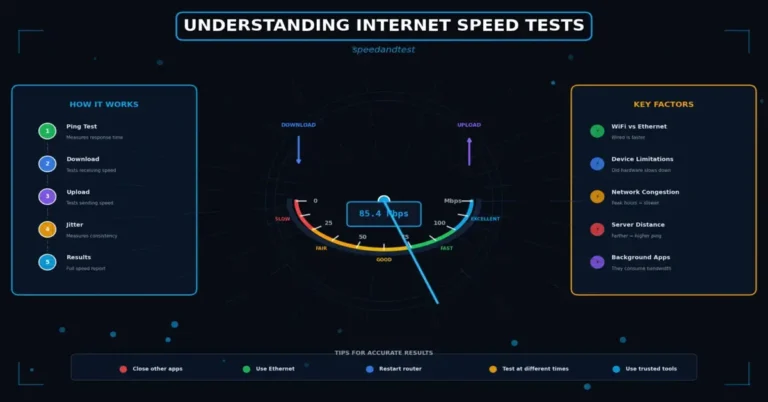
Curious how your current connection actually measures up before you start thinking about next-generation upgrades like Li-Fi technology? Run a free, no-signup speed test at SpeedAndTest.com right now and see exactly what your Wi-Fi is delivering today — because the smartest upgrade decision always starts with knowing your real numbers.
Frequently Asked Questions About Li-Fi Technology
Is Li-Fi technology faster than Wi-Fi?
Yes, under laboratory conditions, ns Li-Fi technology has demonstrated speeds exceeding 224 Gbps, and real-world commercial deployments regularly outperform typical Wi-Fi connections. Because visible light offers roughly 10,000 times more usable spectrum than radio frequencies, Li-Fi has significant headroom to keep improving.
Can Li-Fi technology work through walls?
No, and that’s actually a feature rather than a flaw. Light cannot pass through solid walls, so a Li-Fi technology signal stays confined to the room it’s generated in. That containment is exactly what makes it so appealing for security-sensitive environments.
Do I need special equipment to use Li-Fi technology?
Yes. You need both a Li-Fi-enabled light fixture (the transmitter) and a receiver, which today typically comes as a USB dongle or a built-in module on specialized enterprise devices. Consumer-ready, built-in receivers are not yet standard on typical laptops or phones.
Will Li-Fi technology replace Wi-Fi completely?
Most experts don’t expect that any time soon. Li-Fi technology is better understood as a complement to Wi-Fi, ideal for specific high-security or high-density rooms, while Wi-Fi continues handling broader, whole-building connectivity where light-based line-of-sight limitations would be impractical.
When will Li-Fi technology be available for home use?
There’s no fixed date yet, but market analysts tracking the Li-Fi technology industry project continued growth through the early 2030s as manufacturing costs decline and more device makers integrate receivers directly into consumer hardware.