Future of Internet Connectivity: 5G’s Better Power
Table of Contents
Fifth-generation wireless technology, better known as 5G, represents the most significant upgrade to mobile connectivity in over a decade, promising dramatically faster speeds, lower latency, and the capacity to connect far more devices simultaneously than previous generations of mobile networks. But 5G is not simply a faster version of 4G; it introduces fundamentally new network architecture, use cases, and possibilities that extend well beyond faster video downloads on a smartphone. This article explores what 5G technology actually delivers, how it works, and what it means for the future of internet connectivity across homes, businesses, and emerging technologies.
What Makes 5G the Future of Internet Connectivity Different From Previous Generations
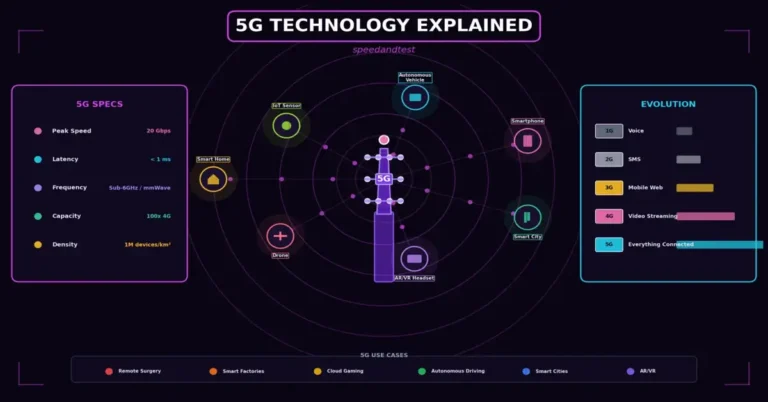
Each generation of mobile network technology has brought a step change in capability. First-generation networks enabled basic analog voice calls. Second-generation introduced digital voice and text messaging. Third-generation brought mobile internet access. Fourth-generation, known as LTE, delivered the fast mobile broadband that made streaming video and modern app-based services practical on smartphones. Fifth-generation networks go further still, targeting peak speeds many times faster than 4G, latency low enough to support real-time applications, and the ability to support a vastly higher density of connected devices per square kilometer.
This last capability, often called massive machine-type communication, is particularly significant because it enables the kind of large-scale device connectivity required for smart cities, industrial sensor networks, and the broader Internet of Things, use cases that would overwhelm the capacity of earlier network generations.
The Three Pillars of 5 G: Future of Internet Connectivity Performance
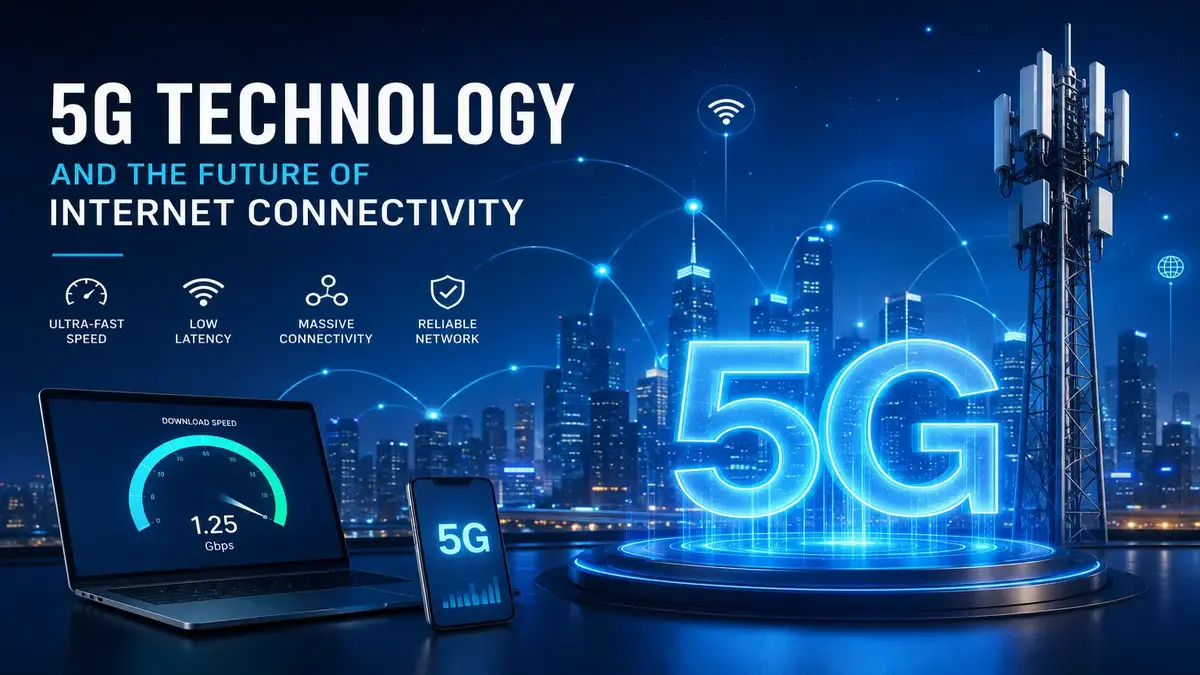
Industry standards organizations generally describe 5G’s improvements across three dimensions: enhanced mobile broadband, which delivers dramatically higher data speeds for consumer applications like streaming and gaming; ultra-reliable low-latency communication, which enables mission-critical applications that cannot tolerate delay, such as remote surgery or industrial automation; and massive machine-type communication, which supports enormous numbers of connected sensors and devices operating simultaneously.
How 5G Networks Achieve Higher Speeds
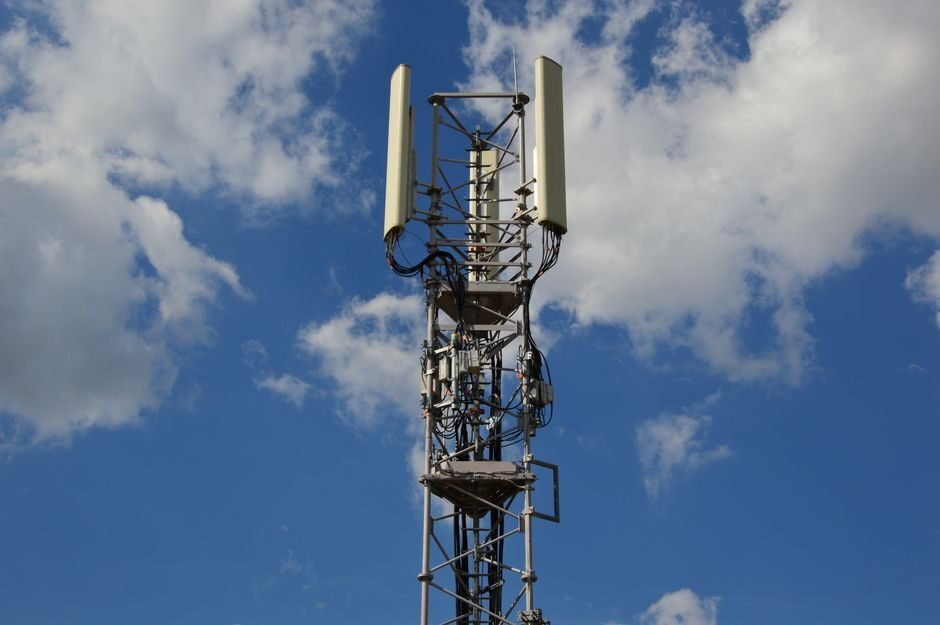
A significant portion of 5G’s speed advantage comes from using higher frequency radio waves, including a range known as millimeter wave, which can carry substantially more data than the lower frequencies used by previous mobile generations. The tradeoff is that higher frequency signals travel shorter distances and are more easily blocked by buildings, trees, and even weather, which is why 5G networks using millimeter wave frequencies require a much denser network of smaller cell sites compared to traditional cellular towers.
To balance coverage and speed, carriers typically deploy 5G across multiple frequency bands: low-band frequencies that travel long distances and penetrate buildings well but offer more modest speed improvements over 4G, mid-band frequencies that balance coverage and speed reasonably well, and high-band millimeter wave frequencies that deliver the most dramatic speed gains but only over short distances, typically in dense urban areas or stadiums where the infrastructure investment makes sense.
Ultra-Low Latency and Its Real-World Impact
While faster download speeds get most of the marketing attention, 5G’s latency improvements may ultimately prove more transformative for certain applications. Reducing latency from the roughly 50 milliseconds typical of 4G networks down to single-digit milliseconds under ideal 5G conditions opens the door to applications that were simply impractical before, including real-time remote control of machinery, responsive augmented and virtual reality experiences, and vehicle-to-vehicle communication systems designed to improve road safety.
5G’s Future of Internet Connectivity Role in Home Internet Service
Beyond mobile devices, 5 G’s future of Internet Connectivity has enabled a new category of home internet service called fixed wireless access, which uses 5G signals to deliver broadband internet to a stationary receiver at a home or business, eliminating the need for traditional wired infrastructure like cable or fiber. This has proven particularly valuable in areas where laying physical cable is expensive or impractical, giving households in previously underserved areas access to substantially faster internet than older technologies like DSL or satellite could provide.
Fixed wireless 5G Future of Internet Connectivity service typically cannot yet match the absolute peak speeds and consistency of a dedicated fiber connection, but it represents a meaningful improvement for many households and a much faster path to broadband access than waiting for wired infrastructure to be built out to every address.
Enabling the Internet of Things at Scale
The proliferation of connected devices, from smart home sensors to industrial equipment monitoring systems, requires network infrastructure capable of supporting enormous numbers of simultaneous, often low-bandwidth connections. Previous mobile network generations were not designed with this scale of device density in mind. 5G’s massive machine-type communication capability specifically addresses this gap, enabling smart city infrastructure like connected traffic systems, environmental sensors, and utility monitoring equipment to operate reliably at a scale that would strain earlier network technologies.
5G and the Future of Internet Connectivity of Autonomous Systems
Autonomous vehicles, drones, and robotics increasingly depend on near-instantaneous communication with surrounding infrastructure and, in some cases, with each other. 5G’s combination of low latency and high reliability makes it a foundational technology for these systems, though it is worth noting that safety-critical autonomous systems typically also rely on onboard sensors and processing rather than depending entirely on network Future of Internet Connectivity, using 5G as an enhancement rather than a single point of failure.
Challenges and Limitations of 5G Future of Internet Connectivity Deployment
Despite its promise, 5G deployment faces real challenges. Building the dense network of small cell sites required for high-band millimeter wave coverage is capital intensive and time-consuming, which is why many 5G Future of Internet Connectivity deployments to date have relied more heavily on mid-band and low-band frequencies that offer more modest but still meaningful improvements over 4G. Additionally, achieving 5G’s full potential requires compatible devices, sufficient backhaul infrastructure connecting cell sites to the broader internet, and, in many regions, updated spectrum policy from regulators to make additional frequency bands available for mobile use.
How 5G Future of Internet Connectivity Fits Into the Broader Connectivity Landscape
5G does not exist in isolation; it is one piece of a broader evolution in how people and devices connect to the internet. Understanding how 5G compares to and complements other connectivity technologies provides useful context for evaluating claims about its impact. For a deeper look at where mobile and wireless technology is headed next, see our article on 5G technology explained, and for a broader view of how these trends fit into the future of digital infrastructure, see the future of internet technology.
The Economics of 5G Network Future of Internet Connectivity Buildout
Deploying 5G Future of Internet Connectivity infrastructure at scale represents one of the largest capital investments the telecommunications industry has undertaken in decades. Carriers must not only acquire spectrum licenses, often through expensive government auctions, but also build out physical infrastructure including small cell sites, fiber backhaul connections to link those cell sites to the core network, and upgraded core network equipment capable of handling 5G’s distinct architecture. These costs are substantial, and they directly shape the pace and geographic pattern of 5G rollout, with carriers naturally prioritizing dense urban and suburban areas where the return on investment is clearest before extending coverage to less populated regions.
This economic reality explains much of the uneven 5G Future of Internet Connectivity experience consumers report across different areas. A city center with strong carrier competition and high population density might enjoy comprehensive, high-band 5G coverage within a few years of initial rollout, while a rural community might wait considerably longer to see anything beyond a modest upgrade over existing 4G service, if a full buildout arrives at all without additional government incentive programs to close the gap.
Network Future of Internet Connectivity Slicing and Enterprise Applications
One of the more technically sophisticated capabilities introduced with 5G Future of Internet Connectivity is network slicing, which allows a single physical network to be partitioned into multiple virtual networks, each configured with different performance characteristics tailored to a specific use case. A manufacturing facility might use one network slice optimized for ultra-reliable low-latency communication to control robotic equipment, while simultaneously running a separate slice optimized for high-bandwidth video monitoring, all on the same underlying physical infrastructure.
This flexibility is particularly valuable for enterprise and industrial customers who need guaranteed performance characteristics for mission-critical applications without the cost of building entirely separate physical networks. Network Future of Internet Connectivity slicing represents a fundamental architectural shift compared to previous mobile generations, which generally treated all traffic on a given network with roughly the same priority and characteristics regardless of the application generating it.
Spectrum Policy and Global Rollout Differences
The pace and character of 5G Future of Internet Connectivity deployment varies considerably from country to country, driven largely by differences in spectrum policy. Countries that moved quickly to auction mid-band spectrum, considered a sweet spot balancing coverage and speed, generally saw faster and more consistent 5G rollout than countries where spectrum allocation was delayed by regulatory or political processes. International bodies work to harmonize spectrum allocation across borders where possible, since consistent global standards reduce equipment costs and simplify roaming for travelers and multinational businesses alike.
Preparing Your Household or Business for the 5G Future of Internet Connectivity
For most consumers, taking advantage of the 5 G future of Internet Connectivity requires little more than upgrading to a compatible device and confirming coverage in your area through your carrier. Businesses considering 5G for specialized applications, such as fixed wireless internet access or IoT deployments, should evaluate coverage quality at their specific location carefully, since indoor signal strength for higher frequency bands can vary significantly based on building materials and distance from the nearest cell site. Consulting with carriers about available frequency bands and realistic expected performance at a specific address helps set accurate expectations before committing to a 5G-dependent service for critical operations.
Frequently Asked Questions
Is 5G the future of Internet Connectivity available everywhere yet?
No. 5G coverage varies significantly by region and even by neighborhood within the same city, with high-band millimeter wave coverage remaining especially limited compared to broader mid-band and low-band deployments.
Do I need a special phone to use 5G?
Yes, 5G requires a compatible device with the appropriate radio hardware. Most smartphones released in the past several years include 5G compatibility, but older devices will continue to operate on 4G networks.
Can 5G Future of Internet Connectivity work alongside Wi-Fi in my home?
Yes. 5G fixed wireless access typically connects to a receiver that then distributes internet access throughout a home via a standard Wi-Fi router, functioning much like a traditional broadband connection from the perspective of connected devices.
Is 5G safe?
Regulatory bodies in most countries have reviewed the radio frequency emissions used by 5G networks and found them to be within established safety limits, consistent with the safety standards applied to previous generations of wireless technology.
Will 5G eventually replace home broadband entirely?
In some areas, particularly those without existing wired infrastructure, 5G fixed wireless access is already replacing the need for traditional home broadband. In areas with strong fiber availability, wired connections generally remain the faster and more consistent option.
How much faster is 5G compared to 4G in practice?
Real-world speeds vary widely depending on frequency band and network congestion, but 5G commonly delivers several times the throughput of 4G under good conditions, with the potential for even larger gains on millimeter wave deployments.
What is network slicing and why does it matter?
Network slicing lets carriers partition a single physical 5G network into multiple virtual networks, each tuned for a specific application’s performance needs. It matters because it allows one network to simultaneously serve very different use cases, from consumer video streaming to industrial automation, without compromise.
Why does 5G coverage vary so much between neighborhoods?
High-band millimeter wave 5G requires a dense network of small cell sites with limited range, so carriers deploy it first in the highest-demand areas. Mid-band and low-band 5G cover much larger areas but with more modest speed improvements over 4G.
Does 5G drain phone batteries faster than 4G?
Early 5G devices did show increased power consumption, particularly when connected to millimeter wave signals, though newer chipsets and network optimizations have substantially narrowed this gap compared to 4G devices.
Will 6G eventually replace 5G?
Research into next-generation wireless standards is already underway, but 5G networks are expected to remain the dominant mobile technology for the remainder of this decade, with 6G representing a longer-term evolution rather than an imminent replacement.
5G technology represents a substantial leap forward in wireless connectivity, with implications that extend well beyond faster smartphone downloads into industrial automation, smart cities, autonomous systems, and expanded home internet access. According to the GSMA’s 5G guide, the technology’s full impact will continue unfolding over the coming years as network deployment matures and new applications emerge to take advantage of its capabilities.